This is a SEO version of Poultry Mortality Composting. Click here to view full version
« Previous Page Table of Contents Next Page »• Small particle size. • Open spaces (porosity).
• Bulk density of approximately 422 kg/m 3 ( 711 lbs/yd 3 ) • pH of 6.5 to 8.0. • Ease of handling. • Absorbency.
• High carbon content.
If dry poultry litter is not available, a mix (by weight) of one part caged layer manure with 0.2 parts sawdust can be used as a substitute. Straw is not recommended as a carbon source as it can result in low temperatures and fluid leaching. Large wood chips and shavings do not work as well due to large particle size, low absorbency and significant time to break down.
Major factors Reasonable range Preferred range
Nutrient balance, C:N 20:1 – 40:1 30:1 – 35:1
Moisture 45 – 65% w.b. 50 – 60% w.b. Temperature 45 – 68 °C (113 – 155 °F) 54 – 66 °C (130 –150 °F) Particle size 0.8-1.2 cm (1/8 – 1/2 in) Depends on material Porosity 30 – 50% 35 – 45% Bulk density <640 kg/m3 (1100 lbs/yd 3 )
pH 5.8 – 9.0 6.5 – 8.0 Oxygen concentration >5% >10%
8 key factors for composting success and acceptable ranges to aim for
when composting
8
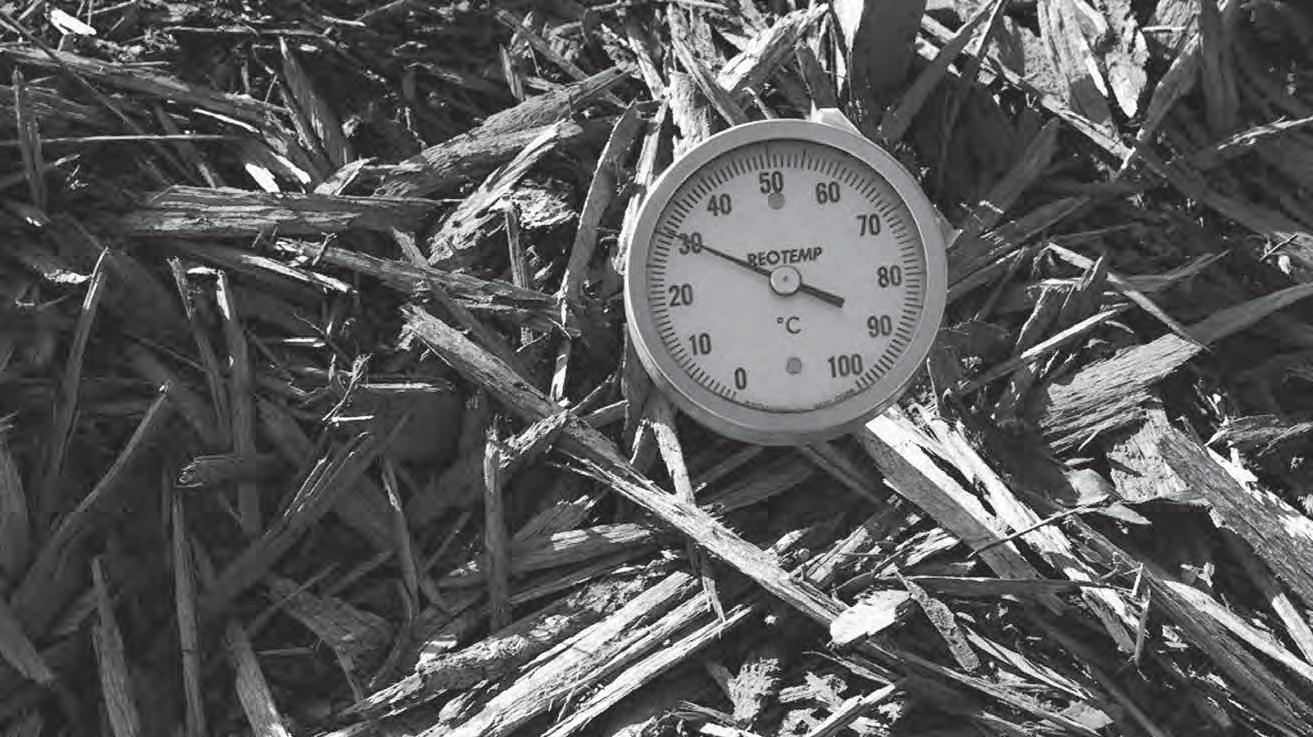
Figure 1. Temperature Measurement
This is a SEO version of Poultry Mortality Composting. Click here to view full version
« Previous Page Table of Contents Next Page »